Talking About White Supremacy
In 2015, Hephzibah Strmic-Pawl introduced the concept of the White Supremacy Flower to teach students about the role of White supremacy in US society across time—from the founding of our country, through its history, to present times. This model brings attention and focus to the social structure that produces White privilege, rather than focusing on the experiences of privilege and oppression.
Naming this system in sociology classes can be challenging, but it is essential. The White Supremacy Flower gives students a vocabulary and a framework for examining the political, economic, and social inequalities. It also offers illustrative examples that they can tie to their own prior knowledge and experiences.
A long-standing pattern of systemic racism is at the heart of our country, including in its very founding documents, across time, and running through our present-era. Even as some White Supremacist practices fall out of favor, new ones emerge. Change, thus, tends to result in new ways of enacting the same ideologies, rather than systemic change.
The White Supremacy Flower helped my Sociology Capstone class digest the history of policing in the US, as documented by Hattery and Smith in their Policing Black Bodies (2017). Chapter One of this book is an essential and overwhelming history of White supremacy and policing. Using the White Supremacy Flower to organize the key ideas and information presented in this chapter allows students to grasp the overarching story, and it gives them the opportunity to recall some of the more specific and essential details. The White Supremacy Flower underscores a major theme of Hattery and Smith’s book—that policing is a practice meant to be applied to Black people as a tool of oppression.
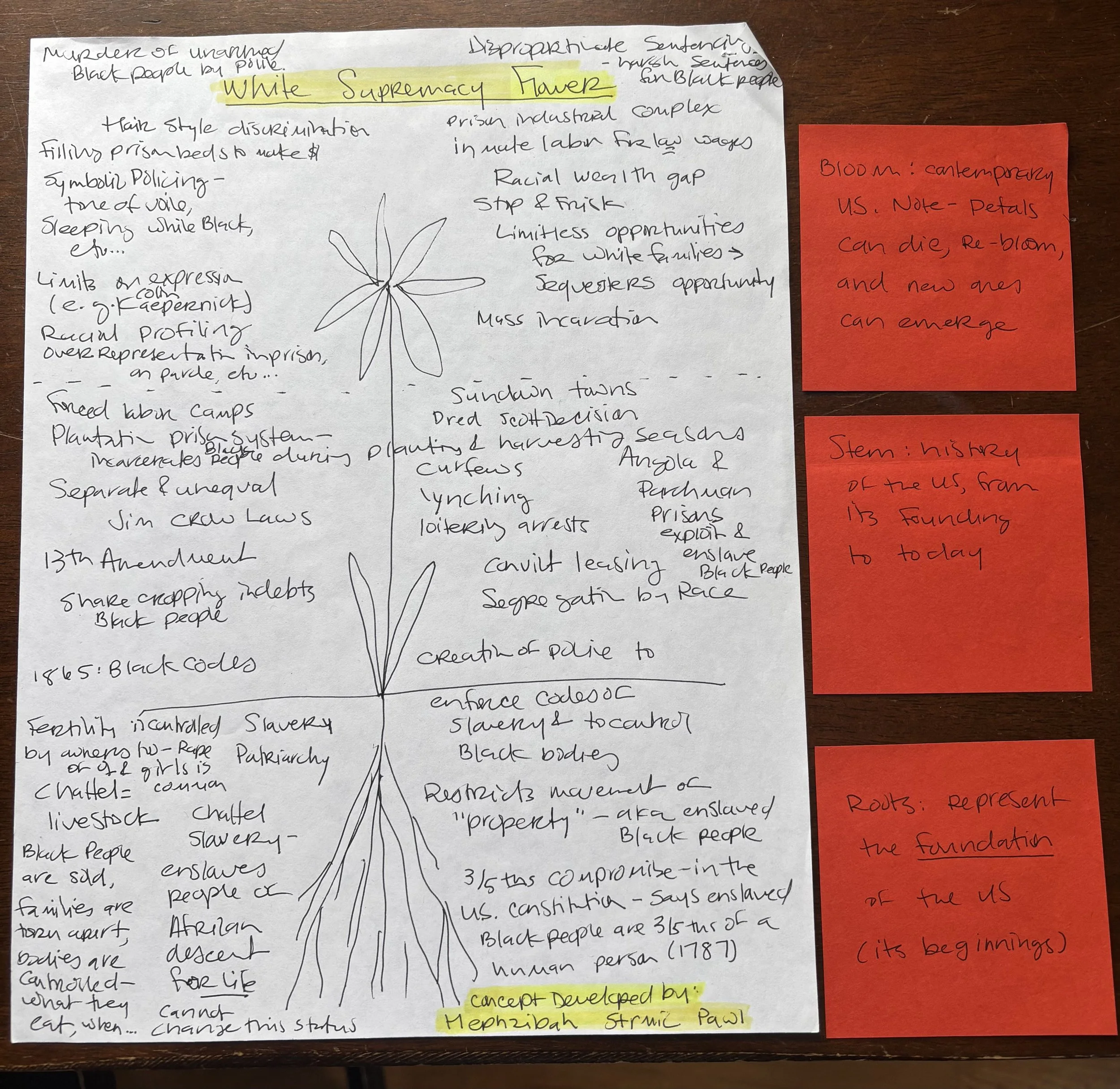
Using the White Supremacy Flower to illustrate Chapter 1 of Hattery and Smith.
The parts of the flower each represent a different point in the US history, with the roots representing the foundation of the United States, the stem representing the history of the US, which includes “both the events and processes” (Strmic Pawl 2015:193). Petals on the bloom correspond to inequalities in the contemporary US (Strmic-Pawl 2015). Sometimes an inequality is addressed, and this petal will fall from the flower, but a new petal can emerge to replace the lost one.
The White Supremacy Flower is an essential tool because it plainly shows how a racial hierarchy is created and sustained in the US, with the placement of Whiteness at the top being intentional.
This is a difficult topic to examine, precisely because it renders many students and their families second class citizens in an overt way. Other students find themselves positioned as oppressors in a sometimes brutal hierarchy. But this is true whether we discuss it openly or not.
Talking about inequality and differences is an important first step in being able to dismantle structures of oppression. Sociology is an amazing field of study because it gives us vocabulary and conceptual tools to facilitate these conversations.
I love sociology because it helps me to understand the social world—and my position within it—a little more every day.