Resisting White Supremacy
Even better than talking openly about White supremacy?
Sociology gives us the tools to talk about the consistent story of RESISTING White supremacy. It is against policy and practice to talk about racism in some places in the US now—even in the face of blatant racism.
But we continue to have the opportunity to speak up about resistance. In the Fall of 2023 I created a model of resistance that mirrors the White Supremacy Flower, which I call the Resistance Flower.
Just as parts of the White Supremacy Flower represent the process of establishing and perpetuating White supremacy across US history through our social, political, and economic systems, so the parts of the Resistance Flower represent the process of rejecting and opposing White supremacy across US history through our social, political, and economic processes. All the while that White supremacy has been established, it has been contested.
For the roots, again representing the founding of the US, we can look to resistance in the form of war and insurgence against first colonial and then the United States incursions. Indigenous peoples did not simply vanish without a trace—they fought back when the outsiders were violent and sought their annihilation (Dunbar-Ortiz 2014).
Enslaved Black people who had been kidnapped and forcibly brought to the thirteen colonies to endure chattel slavery also rejected White supremacy. As early as 1632, there are records of Black people attempting to run away from their enslavers (Zinn 2005). Black people of the time also engaged in sabotage, work slowdowns, or even acts to assert their dignity (Zinn 2005)—all of which reject White supremacy and the ideology that meant that it was appropriate to enslave Black people.
While the march of US history is told in a way that can leave the impression that our social structure and our country’s story were inevitable, looking past the surface of our historical teachings reveals a more complicated story.
For the stem, we can identify both events and processes of White supremacy that were resisted. Black people in the Jim Crow South resisted their unequal status as second-class citizens.
Gordon Hirabiyashi, Fred Korematsu, and Mitsuye Endo resisted Executive Order 9066 in 1942 when they refused to comply with relocation and curfew orders enforced on Japanese Americans. In 1943 Japanese Americans in incarceration camps were asked if they were willing to serve in the United States Armed Forces on combat duty and asked to swear allegiance to the United States while forswearing allegiance to Japan on Loyalty Questionnaires (Takei 2019). While thousands of Japanese Americans chose to answer yes to these questions, there were also many who chose to answer “no” to Questions 27 and 28 (Takei 2019). Japanese Americans were resisting the attempts of the US government to coerce their speech and rejecting the assumption that their allegiance was to any country but the US.
These are just a few examples that could be added to the stem of the Resistance Flower to illustrate rejection of White supremacy in US history.
Finally, in the contemporary US we see active resistance to the many inequalities that persist as a result of White supremacy. #BlackLivesMatter and the many protests and actions that this initial hashtag began, speaks to the inequalities in risk of being killed by police officers, disproportionately impacting Black people, Black lives. Heather Heyer was killed while protesting the White supremacist march in Charlottesville, Virginia. Activists have also worked to #stopAsianhate in the wake of anti-Asian sentiment that arose with the COVID-19 crisis. There will surely be more examples for us to add to our Resistance flower…as we continue the work of resisting White supremacy.
Our resistance to White supremacy is evident in US history. We can see it at the time of the founding of the United States, in the history of the United States, as well as in our contemporary society.
Taking time to examine and honor the resistance can make space for even more resistance to White supremacy and bring us closer to rejecting White supremacy entirely.
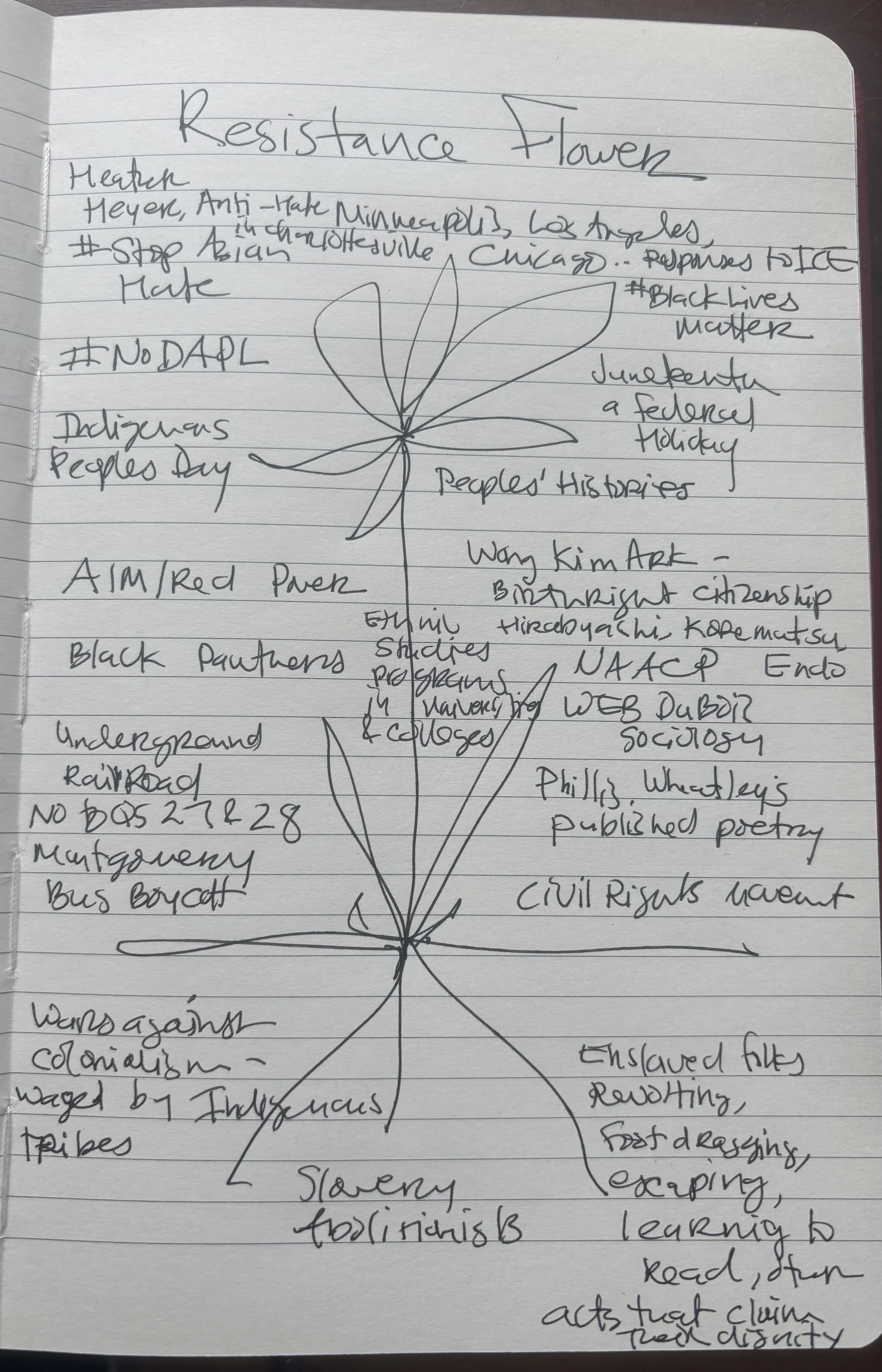
The Resistance Flower: Resisting White Supremacy from the Roots of the US to Today